


In October 2026, the website BookDesignMadeSimple.com (founded by Fiona Raven and Glenna Collett) will be closing, and their co-written book will no longer be available for purchase.
While this is incredibly sad news, Fiona and Glenna have generously allowed me to archive their blog posts on Hadley House to avoid having them disappear with their website. You can find all of their archived posts here.
Fiona and Glenna have made a huge impact on my life, teaching me so much about book design and giving me the hope, motivation, and confidence to succeed in this field. I am eternally grateful. It is an honor to learn from them. I think you will feel the same <3
The excerpt below is from Book Design Made Simple, Second Edition, chapter 6, Planning your pages, page 24. Copyright © 2017 Fiona Raven and Glenna Collett.
Authors often forget about their book front matter until the last minute. Don’t let that happen to you! You need to allow plenty of time to collect some of the data needed on these first several pages, particularly on your copyright page.

In this excerpt from Book Design Made Simple, we offer a list of possible book front matter pages and their proper order.
Book front matter includes some or all of these pages
half title includes just the book title
title page (mandatory) includes the book title, subtitle, author’s name, and (optional) publisher’s company, city, and logo
copyright page (mandatory)
dedication
quote or epigraph
contents (table of contents)
list of illustrations
foreword (written by someone other than the author)
preface (written by the author)
acknowledgments (or they can go at the back of the book)
introduction
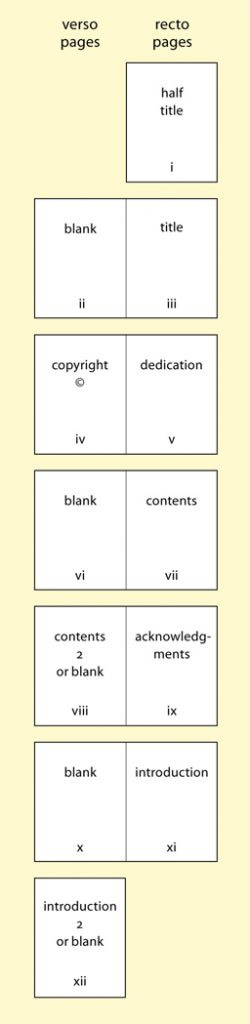
There are only two pages you must include in your front matter: a title page and a copyright page. The title page must go on a recto page, and the copyright page must go on the verso page immediately following the title page (in other words, the copyright page is printed on the back of the title page).
All other pages in the front matter are optional. The usual order of the front matter is shown above. It’s customary to begin each new item on a recto page (which may cause a few blank verso pages), or you may choose not to start each new item on a recto page, and that’s fine too. You may decide that a Contents requiring two pages looks nicer on a spread. You’ll see what suits your book when the time comes.