

Your Book Promotion Materials
This is an archived post from Book Design Made Simple.

In October 2026, the website BookDesignMadeSimple.com (founded by Fiona Raven and Glenna Collett) will be closing, and their co-written book will no longer be available for purchase.
While this is incredibly bittersweet news, Fiona and Glenna have generously allowed me to archive their blog posts on Hadley House to avoid having them disappear with their website. You can find all of their archived posts here.
Fiona and Glenna have made a huge impact on my life, teaching me so much about book design and giving me the hope, motivation, and confidence to succeed in this field. I am eternally grateful. It is an honor to learn from them. I think you will feel the same <3
Originally Published: October 8, 2018
By: Glenna Collett
A book is a wonderful thing! But of course it’s not much good unless people read it, and to make that happen, sometimes you need to go beyond social media and word of mouth. Printed book promotion materials can help you do that, so in this article we hope to help you find just the right combination of giveaways for your book.
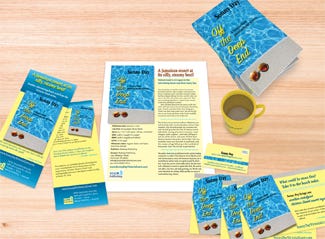
One of the advantages of doing your own book design and typesetting is that you can also produce your own book promotion materials. To reduce the learning curve for you, InDesign Secrets offers free Adobe InDesign templates for all kinds of publications.
You probably don’t need all of the book promotion materials listed below. Read about your options, and then stick with a few of them. For purposes of illustration, we invented an author named Sonny Day with a book called Off the Deep End. Here are the book promotion materials you’ll find in this article:
Bookmarks
Business cards
Postcards
Rack cards
Sell sheets
Posters and banners
Pens and other promo materials
Printers for all of the above
Before you plunge into designing the separate products, think brand identity! Each and every item should match your book cover (or series covers) as much as possible. Use the same background pattern, images, colors, and typefaces. (If you purchased an image from a stock photo company, be sure your user agreement allows you to use it for this kind of material. You might have to pay more for increased rights.) When you’re finished, you should be able to take a picture of all your materials together and be proud of your matched set.
Speaking of brand identity, if your book is related to your business, be sure that they are promoting each other all the time. In other words, your book and business promotion materials should work for both. See our article “Use your book to build business” for more on this.
Remember that this is marketing material, most of it meant to be digested in seconds. Don’t include long reviews or long passages from your book; save those for your website (if you don’t have one yet, read up on creating one here).
Book promotion bookmarks
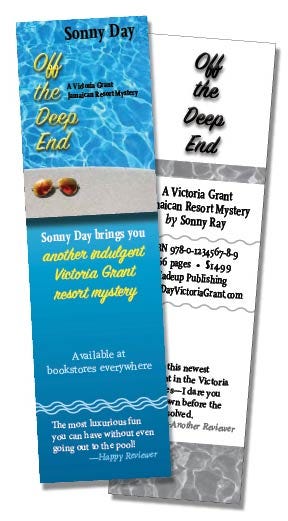
Bookmarks are probably the most common form of book promotion. Small and easy for you to keep on hand, they are readily accepted by just about anyone anywhere. The example to the right is printed on both sides, but you could leave the back blank.
What to include on your bookmark:
Book cover
A short headline to grab the viewer’s interest (a tag line)
Book title, subtitle, and author (if they are too small to be read at a glance on your mini cover)
ISBN
List price
Publisher
Your book’s website
A blurb or two
Where the book can be purchased. Since bookmarks will be picked up mostly by readers, restrict your vendor list to retail only, such as Amazon, Barnes & Noble, and indie bookstores. Don’t list wholesalers (Ingram, Baker & Taylor, etc.) or distributors.
Book promotion business cards
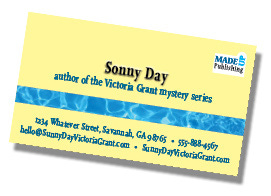
Everyone knows what a business card looks like. Does an author need one? Imagine these situations: You’re pitching your book to an agent or publisher. You’re at a publishing conference meeting new people. You’re offering your services as a speaker. You bump into a famous author.
What to include on your business card:
Your name
Book or series title
Book cover if it fits (optional)
Publisher
Email address
Phone number
Physical address (optional)
Web address
Book promotion postcards
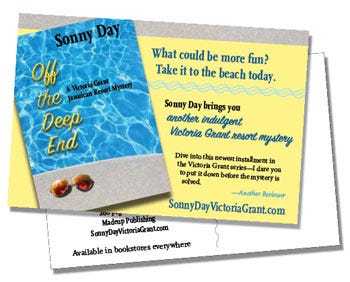
Who sends postcards these days? A few savvy marketers, that’s who. A postcard might capture more interest than an email, it lasts a lot longer, and it can double as a bookmark, too. Even if you don’t put a single one in the mail, postcards might work very well for you as handouts. Before designing a postcard, check the acceptable sizes for the US Postal Service and/or Canada Post. The example here is printed on both sides, but leave the back blank if you like.
What to include on your postcard:
Book cover
A strong tag line
Book title, subtitle, and author (if they are too small to be read at a glance on your mini cover)
ISBN
List price
Publisher
Your book’s website
Perhaps a blurb or two
A very short passage (for fiction)
A short list telling how the book will help the reader (for nonfiction)
Where the book can be purchased. If your postcards are meant for retailers and librarians, include wholesale as well as retail information.
Blank space for writing an address
Book promotion rack cards
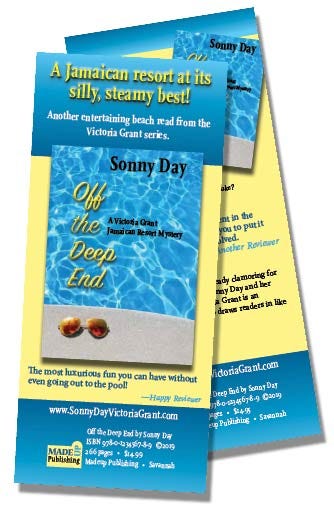
What is a rack card? It’s a 4″ wide × 9″ high two-sided card that will sit in a rack with other cards of the same size. (Picture the cards set out for tourists in a hotel lobby.) At a book fair or in an exhibit hall display you might be asked to supply rack cards for visitors to pick up. Because of the dimensions of the rack, other printed materials might not be accepted; check with the event organizer.
It’s well worth your time to word and design a rack card carefully for your intended audience. Write a headline that catches the viewer’s attention from a distance—sometimes only the top 1 inch of the card will be visible while it’s in the rack.
You have more space than on a postcard or bookmark, but don’t cram it with words. Use empty space to draw the reader in; fewer words are always more effective than more.
What to include on your rack card:
A punchy headline
Book cover
Title, subtitle, and author
ISBN
Copyright date (if it’s recent)
List price
Publisher (with logo)
Other titles in this series (if you have one)
Your book’s website
A blurb or two
A catchy passage (for fiction)
A list that details how the book will help the reader (for nonfiction)
Where the book can be purchased. If the audience is retailers and librarians, include wholesale as well as retail information
QR code that leads to your website (optional)
Book promotion sell sheets
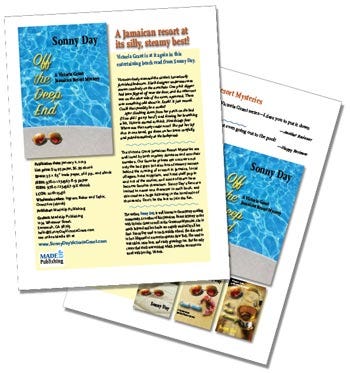
A printed sell (or sales) sheet might seem outmoded these days, but consider producing a few anyway. It’s a consolidated version of all of the promotional information on your website and is meant to be handed to librarians, booksellers, and anyone who might invite you to speak at an event. You can include the sell sheet on your website by attaching it as a PDF.
The sell sheet is printed on unfolded 8.5″ × 11″ paper, usually on both sides.
What to include on your sell sheet:
Book cover (it can appear more than once)
Title, subtitle, and author
A different strong headline for each side
ISBN
LCCN
Copyright date
Number of pages
Any notable features such as bibliography, glossary, index, illustrated, etc.
List price
Publisher (with logo)
Other titles in this series (if you have one)
Your book’s website
Your contact information
Book synopsis
A catchy passage (for fiction)
A list that details how the book will help the reader (for nonfiction)
Images from the book if appropriate
Reviews
Wholesale information
You will find more about sell sheets by searching online for “book sell sheet.” Start with this article by Judith Briles (via The Book Designer).
Book promotion posters and retractable banners
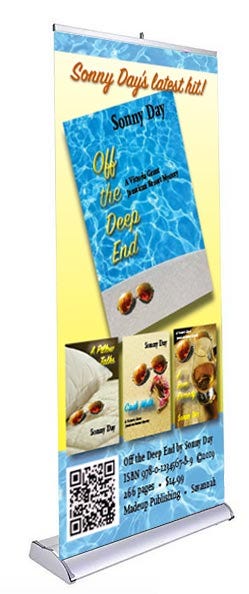
These are for the author who gives presentations or who appears at fairs or book shows. Before designing anything, read all the rules for the event and consider the amount of space you will have at your booth, or how much time you will have as a presenter. (Don’t have a huge banner printed for yourself if you’re going to be sharing the stage with others.)
Make the type big enough! Fill the space! Ask for advice from your printer, as this is the most common mistake made by beginners. Make sure there’s enough contrast between the background color and the type. Posters and banners need to be visible from a great distance; but if they will hang from the edge of a table, don’t put anything important down next to the ground. Coming up with a poster or banner design that will fit all occasions is not easy.
Ask your printer about indoor/outdoor materials that you can use in any location.
What to include on a poster or banner: This depends on your audience and your message, which should be whittled down to the bare bones. It also depends on how much space you have. So include some, but not all, of the following:
Your book title, plus author name and book cover (if they fit)
Snappy promotional headline
Publisher
Book list price
A QR code that links to your website (optional)
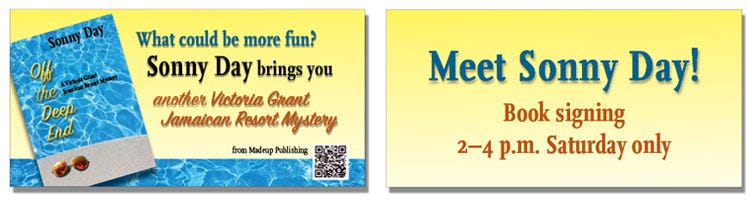
Book promotion pens, sticky notes, and other gifts
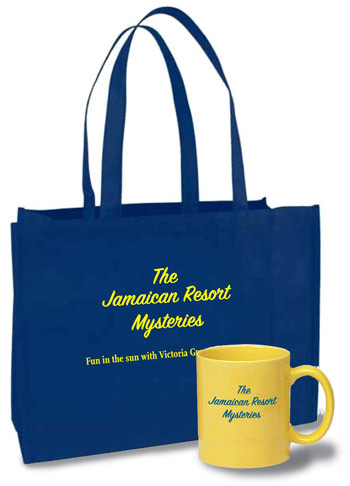
At your book launch or at other venues you might want to hand out more valuable gifts such as pens, sticky notes, mugs, tee shirts, or other items as appropriate.
We suggest going to a promotional gift supplier and using their templates to fit your copy in the designated space. Keep your design(s) as simple as possible for the highest impact.
What to include on promotion gifts: Author name? Book title? Series title? Protagonist’s name? A short, catchy phrase? Publisher name and logo? Website? This is up to you.
Printers for all of the above
We suggest that you try local printers first. They are usually friendly, accommodating, and pleased to begin a working relationship with you. If there’s nobody in your area, try the online printers listed below. Compare the following: available trim sizes, available quantities, how many colors can be printed on each side, printing and shipping costs, and speed of delivery. Read online reviews, too.
Look for templates and/or guidelines for the various products. Information can include bleed amounts, margins, color range, and type sizes.
Note that we are not promoting any of the companies below, as we have not worked with all of them.
4AllPromos prints on a wider array of materials.
4imprint prints and embroiders on many products.
We wish you the best of luck with your book promotion materials and hope that they help you sell lots of books!