

Reference Books for Book Designers
This is an archived post from Book Design Made Simple.

In October 2026, the website BookDesignMadeSimple.com (founded by Fiona Raven and Glenna Collett) will be closing, and their co-written book will no longer be available for purchase.
While this is incredibly bittersweet news, Fiona and Glenna have generously allowed me to archive their blog posts on Hadley House to avoid having them disappear with their website. You can find all of their archived posts here.
Fiona and Glenna have made a huge impact on my life, teaching me so much about book design and giving me the hope, motivation, and confidence to succeed in this field. I am eternally grateful. It is an honor to learn from them. I think you will feel the same <3
Originally Published: December 4, 2017
By: Fiona Raven
Ask any book designer about their collection of reference books and you’ll get a long list of the usual suspects: books about design, typography, layout, and grids; dictionaries and style guides; software manuals; and lots of books and magazines kept for inspiration. But which books are indispensable to a book designer?

Here is a list of the reference books that we refer to often and would not want to be without:
Designing and typesetting book pages
Thinking with Type, Third Edition
by Ellen Lupton, published by Princeton Architectural Press, © 2024.
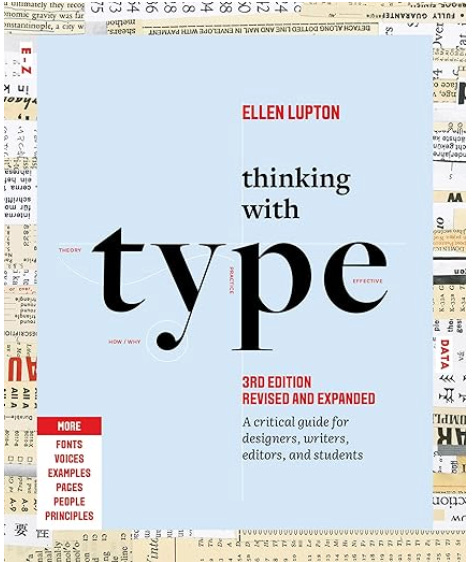
This book is gorgeous and packed with fascinating design examples. It covers the history and current uses of type, typesetting, and grids—the three elements of book design—with just enough detail to cover it all, plus a good touch of humor. This highly readable reference book is used widely in design schools, and for very good reason. Anyone who has been bitten by the graphic design bug should give it a try. —GC
Typographic Style Handbook
by Mitchell & Wightman, published by Libanus Press, © 2018.
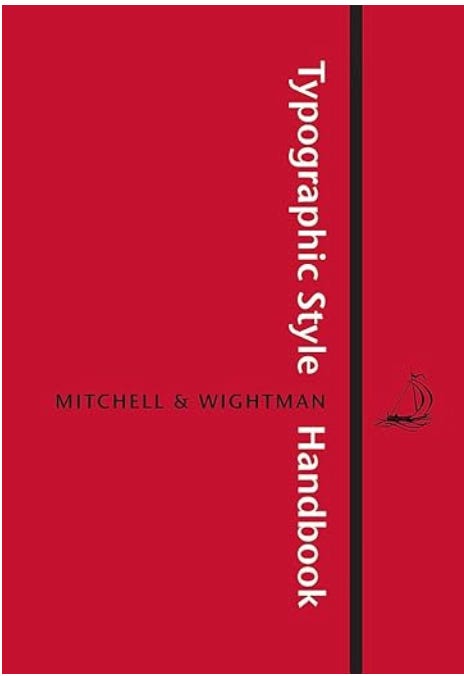
This is a great reference book written by two leading typographers about book layout and typesetting. Need options for laying out pages? Wondering how to choose a typeface, size, and position for captions? Visual examples and clear explanations are given for various elements including contents, headings, chapter openings, running heads, folios, drop caps, footnotes, captions, and so on. The authors are British, so some of the expressions are a bit different from what we use in North America (“extent” instead of “page count,” for example), but the few differences are not an issue. —FR
Typesetting reference book
The Chicago Manual of Style, 18th Edition, University of Chicago Press, © 2024. Also available through an online subscription.
I use this reference book more than any other except perhaps for my dictionary. It’s filled with rock solid information for editors, proofreaders, and yes, typesetters. Every publisher, editor, and book designer in North America should own a copy, as it is the standard reference on grammar, punctuation, numbers and math, captions, tables, typesetting foreign languages, and much more. CMOS keeps up with the trends and leads the way in dealing with new phenomena. For instance, it tells how to break a URL onto two lines properly (it’s not the way you think). —GC
Color guides for print
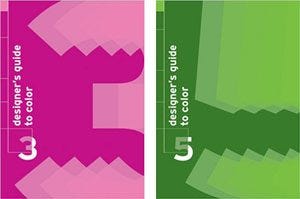
Designer’s Guide to Color (Book 3) and Designer’s Guide to Color (Book 5), by Ikuyoshi Shibukawa and Yumi Takahashi, published by Chronicle Books, © 2006.
These little books contain thousands of color combinations printed on coated stock, and provide the CMYK values of every color so you can see how they’ll look in print. I have all five books in the series. Books 3 and 5 are particularly awesome, as they show all kinds of beautiful color patterns that are indispensable for choosing a color palette. Book 3’s color patterns include gingham, argyle, plaid, tartan, camo, florals, and paisley, as well as Islamic, Indian, Japanese, African, and Latin American patterns. Book 5’s color patterns are based on moods: romantic, sporty, subdued, cool, elegant, and chic, just to name a few. With these books, you can create color palettes with confidence, knowing how the colors will look printed and how they’ll look in combination with each other. —FR
Books for inspiration
Layout Index by Jim Krause, published by North Light Books, © 2001.
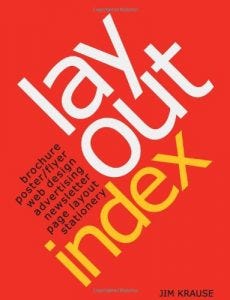
It’s small, it’s fun, and it’s bursting with ideas for any kind of publication layout. This is not one of those reference books showing wild, useless designs; each one is completely practical. I flip through the book all the time, and it never fails to give me a boost.
There’s a whole series of these wonderful little idea volumes: Color Index, Color Index 2, Design Basics Index, Idea Index, and Type Idea Index. Buy one and you’ll soon want more. —GC
Book, Jacket & Journal Show Catalog (now available online), published annually by the Association of American University Presses.

These catalogs are filled with beautiful examples of fine book design. Each award-winning book in the show garners its own two-page spread in the catalog, displaying its front cover and a few select pages (usually its title page, contents, and chapter opening). What I particularly love about these catalogs is that they include information about which fonts are used for display type and text, as well as trim size, page count, paper stocks, binding, and where the book was printed. Printed catalogs are available here, or view the winning covers and pages online here (online viewing doesn’t include info about fonts, paper stocks, etc.). —FR
Just one more
Book Design Made Simple by Fiona Raven and Glenna Collett, published by 12 Pines Press, © 2017.
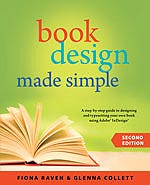
And guess what? We both use Book Design Made Simple all the time! We worked very hard to make it as useful as possible, and we often look up information that the other wrote. It’s one of the handiest volumes we own.